
Highest Payout Online Casino Australia: What to Know
When you’re chasing fast, reliable payouts, it helps to know which casinos have built a reputation worth your attention before you commit your money and time.
Thor Casino is a Nordic-themed platform that has carved out a spot among online casinos catering to players seeking a distinct, immersive gaming atmosphere.
Betvictor is a long-standing name in online betting and gaming, recognised for its established presence in the wider gambling industry.
Tabcorp is a well-known, established name in the Australian wagering and gaming sector, carrying significant industry recognition.
Vegaz Casino positions itself as a modern online casino aiming to offer players a broad and engaging gaming experience.
Jeetcity Casino is an online casino brand that has found a place among platforms competing for players looking for variety in their gaming options.
JustCasino offers a straightforward online casino experience, appealing to players who value simplicity in their gaming platform.
WinSpirit Casino is an online gaming platform recognised for providing players with an accessible casino experience.
Betfair is a globally recognised betting exchange and gaming brand known for its long-standing presence in the industry.
CasinoStars is an online casino brand that has attracted attention as part of the broader field of gaming platforms available to players.
Lucky Dreams is an online casino known for cultivating a dream-themed identity within the competitive online gaming space.
Table of Contents
- Legal landscape for online casino payouts in Australia
- Fast payouts and withdrawal speeds you can expect
- What makes a casino high‑paying and how slots fit in
- Slot machines with the biggest payouts
- Casino games that give the best returns
- Which specific slot machines top the payout charts?
- How payout percentages are calculated and what to look for
- Pokies: Australian slot machines and their payouts
- Understanding payout rates and RTP numbers
- Finding online casinos that combine slots with high payouts
Legal landscape for online casino payouts in Australia
First thing I tell anyone asking me about the highest payout online casino Australia 2026 has to offer: check the legal picture before you check the RTP numbers. I didn’t, back when I started. I assumed if a site let me deposit in Australian dollars and showed kangaroo-themed slots, it was somehow "legit" here. Wrong assumption, and it cost me a few frustrating weeks of unanswered support tickets.
Here’s the actual situation. Australian gambling law simply doesn’t have a provision that allows any form of online casino gambling. Not "restricted," not "regulated with conditions" — there’s no legal pathway for it at all. The rule that governs this space is the Interactive Gambling Act, and its whole purpose is to draw a line around what interactive gambling services can legally be offered to people in Australia. Online casino games — pokies, blackjack, roulette, the lot — fall outside what’s permitted.
What that means in practice is that Australian regulators generally don’t license real-money online casino sites aimed at local players. There’s no local seal of approval you can look for, because the body that would issue one isn’t in the business of issuing it for this category. That’s a very different setup from sports betting, which operates under its own licensed structure in Australia.
So where do people actually play?
This is the part that confused me the most at first. If it’s not legal to license these sites here, why does every casino ad I see seem to be talking directly to Australians? The answer is that Australians commonly use offshore online casinos — sites licensed and operated from outside the country, serving Australian players without being licensed by an Australian authority themselves.
Offshore operators not regulated
Australian players should be aware that offshore casinos are not overseen by Australian regulators, so any dispute may be harder to resolve.
"Offshore" sounds sketchy the first time you hear it. It isn’t automatically a red flag. It just means the casino answers to a different regulator than the one that would apply if this kind of gambling were licensed domestically — which, again, it isn’t. The quality and trustworthiness of an offshore operator has nothing to do with the word "offshore" itself and everything to do with who’s actually checking their books, their RNG, and their payout behaviour. That’s a separate question from the legal framework, and it’s one worth digging into before you deposit a cent.
Why this matters for payouts specifically
I’m not covering withdrawal speeds or payment methods here — that’s its own conversation. But the legal backdrop explains a lot about why payout experiences vary so much between sites claiming to serve Australian players. Because there’s no domestic licensing regime for online casinos, there’s no single domestic body enforcing consistent payout standards, dispute resolution, or minimum RTP requirements across the market. Whatever protections you get come from wherever the site itself is actually licensed and audited — and that varies enormously from one operator to the next.
This is exactly why the "highest payout" claim you see plastered across so many casino homepages needs a second look rather than a nod. Without a local regulator setting the floor, the gap between a genuinely well-audited site and one just borrowing the language of fairness is wider than most new players expect. I learned to stop reading the marketing and start reading the licensing footer instead.
None of this means Australians can’t play responsibly or that offshore sites are inherently unsafe. It just means the safety net looks different than it does for, say, a UK player under UK Gambling Commission oversight. Keep that distinction in mind as we get into speeds, RTP figures, and what "high-paying" actually means in the sections ahead.
18+ only. If gambling stops being fun, Gambling Help Online and Gamblers Anonymous Australia are there, and the national helpline is 1800 858 858.
Fast payouts and withdrawal speeds you can expect
Here’s the thing nobody tells you upfront: the highest paying online casino in Australia isn’t just about generous RTP. It’s also about how long you wait to actually see your money. I’ve had wins sit "processing" for what felt like forever at some sites, and I’ve had others land while I was still making coffee. The difference wasn’t luck. It was the withdrawal method and the casino itself.
Fast withdrawal casinos process payouts in hours instead of days. That’s the baseline you should expect from anything calling itself a highest paying casino. If a site quotes you multiple business days as standard, that’s not a "processing time." That’s a red flag with a nice font.
PayID: the option most Australians overlook
PayID withdrawals typically clear within 1‑2 hours. It runs through the same rails as your regular banking, so there’s nothing exotic to set up, no new app, no waiting on a wallet address. You link it once during verification and it just works after that. Out of everything I’ve tested, this is the one I default to now. Fast, familiar, no surprises.
What actually determines your wait time

A high‑paying casino can have the best slots on the market and still make you wait, because the payout speed depends on more than the games. It comes down to how quickly the casino itself approves the withdrawal, and how quickly the payment method moves once it’s approved. Get either one wrong and the whole thing slows down.
That’s why I stopped judging a casino purely by its RTP numbers or bonus offers. A "fast" casino means nothing if your money still takes days to actually reach your account.
A rough guide to what you’ll see
| Method | What to expect |
|---|---|
| PayID | Clears within 1‑2 hours |
| Other bank‑linked methods | Can take considerably longer depending on the casino |
I’d treat PayID as the benchmark. If a casino offers it and still drags its feet, that’s the casino’s processing time causing the delay, not the payment rail. Worth remembering before you blame the bank.
None of this replaces doing your own homework on a site before you deposit. Check the withdrawal methods listed before you sign up, not after you’ve won something and are stuck waiting. Saves a lot of refreshing your banking app for no reason.
18+. Gambling can be addictive. If it’s stopped being fun, call 1800 858 858.
What makes a casino high‑paying and how slots fit in
I used to think "high payout" was just marketing filler, the same kind of phrase that sits next to "trusted" and "premium" on every casino homepage. Then I actually compared a few sites side by side, checked what they meant by it, and realised the term has a real definition behind it. A high‑paying online casino gives you better chances of winning and larger payouts than the average site. That’s it. Not luck, not a "hot streak" the site is having this week — it’s math, and the math is published if you know where to look.
RTP
Return to Player (RTP) is the theoretical percentage of all wagered money that a game returns to players over the long term.
The number that matters is RTP, or Return to Player. It tells you what percentage of all money wagered on a game gets paid back to players over the long run. Play a slot with a 96% RTP long enough and, on average, 96 cents of every dollar staked comes back to the player pool. The other 4 cents is the house edge. Simple, except most players never check it before they load their card details.
Where the bar actually sits
Many high‑paying casinos offer games with RTP of 96% or higher. That’s a reasonable baseline — anything below it and you’re playing games stacked harder against you than they need to be. But Australian players specifically should be looking a notch above that. High‑payout casinos in Australia offer games with RTP of 97% or greater. If a site’s slot library is sitting under that mark across the board, it’s not a "high‑paying" casino, whatever the homepage banner says.
I made the mistake early on of judging a casino by its bonus size instead of its RTP. Big "welcome bonus," terrible game selection underneath it. Learned the wrong lesson twice before it stuck.
Who actually checks the numbers
Here’s the part that separates a genuinely high‑paying casino from one just claiming to be. RTP percentages aren’t something the casino gets to announce on its own word — they’re verified by independent testing agencies such as eCOGRA, iTech Labs, or GLI. These are third parties with no stake in whether you win or lose. They pull game data, run it against the advertised RTP, and confirm the numbers match what’s actually happening on the servers.
Look for eCOGRA, iTech Labs, or GLI certificates in the casino footer to verify that RTP figures have been independently audited.
Reputable online casinos display eCOGRA or iTech Labs certificates confirming fair audits, usually as a small badge in the footer that nobody clicks on. I didn’t either, for a long time. Now it’s one of the first things I look for — right after checking the site even has a footer worth scrolling to.
There’s a second layer to this, separate from RTP but just as important: the randomness of the game itself. Online casinos use certified RNG technology and undergo independent fairness audits to confirm that outcomes aren’t rigged, patterned, or nudged in the house’s favour beyond the built-in edge. RTP tells you the long-run payout. RNG certification tells you the short-run results aren’t fixed. You want both. A slot can have a great advertised RTP and still feel wrong if the RNG behind it has never been audited by anyone outside the company that built it.
Why slots are the test case
Slots are where all of this becomes visible, because slots are where casinos publish RTP figures game by game rather than as one vague site-wide average. A table game has a fixed, well-known return baked into its rules. A slot’s RTP depends entirely on how the game was built — the reel weighting, the bonus frequency, the volatility curve — and that’s set by the studio, then checked by the labs above. Two slots that look identical on screen can sit five percentage points apart in RTP, and the only way to know is to check the certified number, not the graphics.
This is also why the slot section of a casino tells you more about the operator than almost anything else on the site. A casino that only stocks obscure, unbranded titles with no visible RTP listing is a casino that hasn’t bothered to be checked. One that carries a wide spread of certified titles, with RTPs published game by game, has at least done the paperwork. It doesn’t guarantee you’ll win — nothing does — but it means the odds you’re playing against are the odds on paper, not whatever the house feels like that day.
A short list before you trust the label
Before treating any site as genuinely high‑paying, I run through the same checks now:
- Does it show an eCOGRA or iTech Labs certificate, not just a logo pasted in the footer for looks?
- Are individual slot RTPs listed, or just a vague “up to” claim for the whole site?
- Does the average sit at 97% or above, not just scraping past 96%?
- Is there any mention of RNG auditing beyond the RTP figure itself?
Miss two or more of those and the "high‑paying" label is doing more work than the casino is.
Slot machines with the biggest payouts
I used to think "highest payout slot machine" was a title someone official handed out, like a trophy. Spent way too long googling for a definitive list before I figured out that’s not how any of this works. There’s no single machine crowned champion. What exists is a range of games with published RTP figures, tested and re-tested, and some sit noticeably higher than others.
That’s the honest starting point. When people search for the slot machine with the highest payout, they usually want a name they can type into a search bar and trust. What you actually get, if you do this properly, is a shortlist of titles that consistently land in the upper RTP bracket — and a way to verify that the number on the page matches what the game actually does.
Why "biggest payout" means RTP, not jackpot size
First mistake I made: confusing a big jackpot with a high payout rate. A slot advertising a massive progressive jackpot can still run on a lower RTP, because the odds of hitting that jackpot are stretched thin to fund the prize pool. A game with no flashy jackpot at all can quietly return more to players over time.
RTP is the number that actually tells you what a machine gives back across its lifetime of spins. Many high‑paying casinos offer games with RTP of 96% or higher, and the ones marketing themselves specifically as high‑payout casinos in Australia tend to stock titles at 97% or greater. That gap between 96 and 97 sounds small on paper. Play enough sessions and it stops being small.
Jackpot vs RTP
While progressive jackpots can offer massive one‑off wins, they often have lower overall RTP because a portion of each bet funds the jackpot pool. Regular high‑RTP slots provide steadier returns over time.
So when I’m asked which slots have the highest payout, I don’t look for the biggest banner or the loudest jackpot ticker. I look for the RTP figure, and then I look for who checked it.
What "verified" actually looks like
This is the part most players skip, and it’s the part that matters most. Any studio can print a number on a game’s info screen. What makes that number worth anything is independent testing.
RTP percentages are verified by independent testing agencies such as eCOGRA, iTech Labs, or GLI. These aren’t marketing partners — they’re the labs that run the math models and confirm the game behaves the way the studio says it does. Reputable online casinos display eCOGRA or iTech Labs certificates confirming fair audits, usually somewhere in the footer or on a dedicated fairness page. If a casino doesn’t show that anywhere, that’s not proof it’s rigged, but it’s a reason to dig further before you trust the RTP figures listed next to each game.
Online casinos also use certified RNG technology and undergo independent fairness audits — that’s the mechanism sitting underneath the RTP number. The RNG (random number generator) decides outcomes spin by spin; the audit confirms that generator isn’t tilted. Two separate checks, both needed, neither one optional if you want the payout figure to mean something.
The kind of slots that tend to top the charts

Once you filter for verified RTP instead of jackpot noise, a pattern shows up. The slots that consistently land near the top of the payout range tend to share a few traits:
- Simpler mechanics. Classic three‑reel or straightforward five‑reel games often carry higher RTP than elaborate bonus‑feature slots, because there’s less mathematical overhead built into side features.
- Fixed jackpots or none at all. Games without a progressive pool don’t need to shave RTP to feed a growing prize, so the baseline return tends to sit higher.
- Long-established titles from major studios. Providers with a long testing history — the kind of catalogue you’d find certified by eCOGRA or iTech Labs — tend to publish consistent RTP figures across multiple independent audits rather than a single unverifiable claim.
- Table-game-adjacent slots. Some video slot variants built closer to traditional game structures (fewer special symbols, simpler paytables) show higher long-run returns than heavily-themed feature slots.
None of that means a slot with big bonus rounds and free spins is automatically a bad bet. It means the flashier a game looks, the more worth checking its actual certified RTP before assuming it pays well.
How I actually check a slot before trusting the number
Here’s the process I settled on after wasting time on guesswork:
How to verify a slot
View the game’s information or paytable screen where the RTP is usually displayed.
Compare the RTP number with the casino’s certification page, if available.
Ensure the certification mentions a recognised agency such as eCOGRA, iTech Labs, or GLI.
If the numbers match and the agency is listed, consider the RTP reliable; otherwise treat it as unverified.
- Open the game’s information or paytable screen — most slots list RTP right there, sometimes buried under a small “i” icon.
- Cross-check that number against the casino’s certification page, if one exists.
- Look for the testing agency’s name attached to that certification — eCOGRA, iTech Labs, or GLI are the names to watch for.
- If none of that information is visible or the numbers don’t match between the game and the casino’s own disclosures, treat the advertised payout figure as unverified.
Takes a few minutes. Saves you from chasing a number that was never checked by anyone outside the studio’s own marketing team.
RTP ranges you’ll actually see
| RTP band | What it generally signals |
|---|---|
| 94–95% | Below the threshold most high-paying casinos advertise |
| 96% | The floor for what many high-paying casinos list as their standard |
| 97% and above | The range Australian high-payout casinos are built around |
I’m not listing specific percentage figures for individual slot titles here, because those numbers shift between operators and even between game versions on different platforms. The same title can carry a slightly different certified RTP depending on which casino licensed it and which lab tested that particular build. That’s exactly why checking the certificate on the specific site you’re playing on matters more than trusting a number you saw quoted somewhere else.
Jackpot slots vs steady-return slots
Worth separating these two categories properly, because people often ask about "biggest payout" meaning the biggest possible single win, not the best long-run return.
Progressive jackpot slots can produce the largest individual payouts — that’s the entire design. But the RTP on those games is usually structured differently, because a slice of every stake feeds the growing jackpot pool rather than returning to players through regular wins. Steady-return slots, the ones with high, certified RTP and no massive jackpot, pay out more evenly over time but won’t hand you a single life-changing win.
Neither is "better." They answer different questions. If the search in your head is "what pays out the most overall," you want the certified RTP figure. If it’s "what could pay out the most in one spin," you’re really asking about jackpot structure, which is a different conversation than payout rate.
Remember: a high‑RTP slot offers consistent long‑term returns, whereas a progressive jackpot slot aims for a rare, large payout but usually has a lower RTP.
I mention this because most of the disappointment I’ve seen — my own included — came from mixing the two up. Chasing a jackpot slot expecting steady high-RTP returns, or picking a plain high-RTP game and expecting a jackpot-sized outcome, is a mismatch of expectations, not a scam.
What I actually check before I load funds into a slot
Short list, and it hasn’t failed me yet:
- RTP listed on the game itself.
- That figure backed by a certificate from eCOGRA, iTech Labs, or GLI somewhere on the casino site.
- RNG disclosure confirming the game underwent an independent fairness audit, not just an internal check.

Three things. If any one is missing, I don’t assume the worst, but I also don’t assume the best. I just look elsewhere.
That’s really the whole approach. Not a secret list of miracle machines — just verified numbers, checked against the right names, before you decide where your money goes.
Gambling should stay entertainment, not income. Set limits before you play, and if it stops feeling fun, that’s the signal to stop. Support is available through Gambling Help Online or by calling 1800 858 858. 18+ only.
Casino games that give the best returns
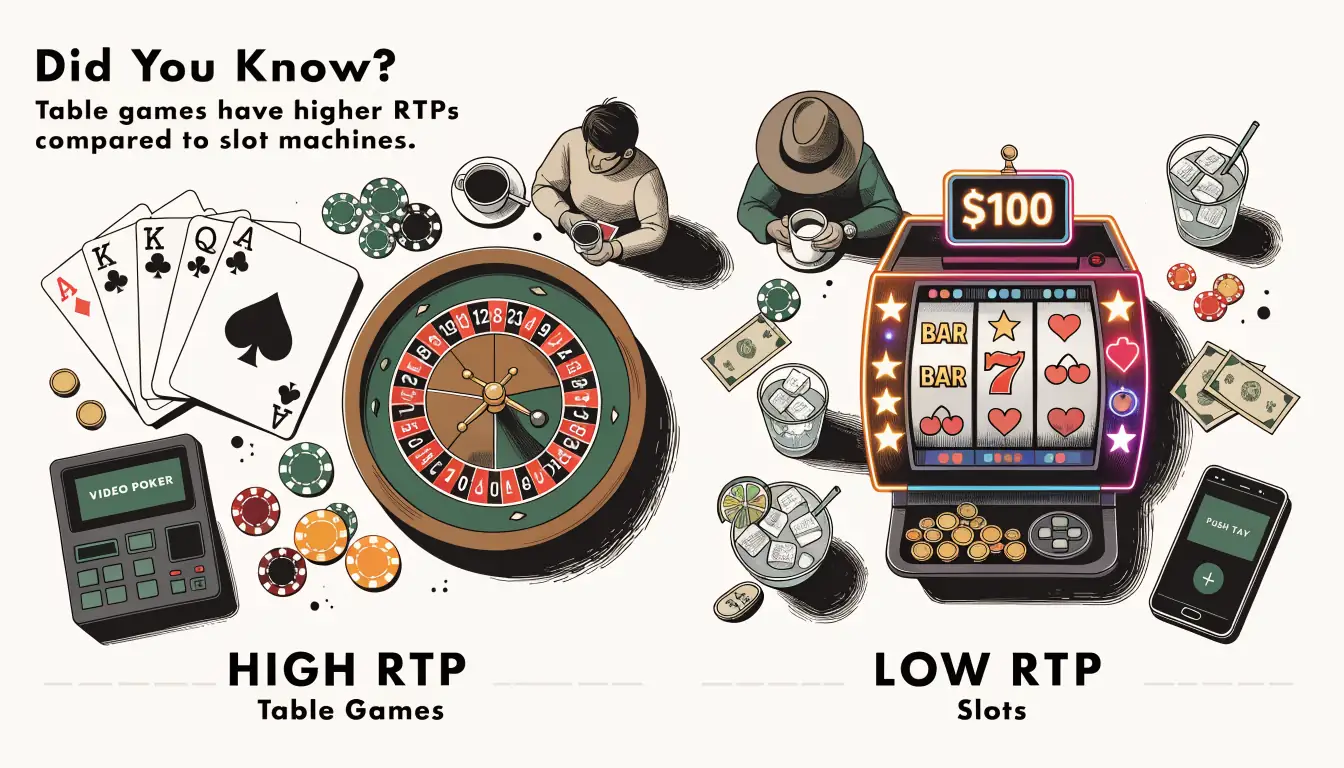
Slots get all the attention, but they’re not where the best casino games with the highest payout actually live. Table games and video poker variants routinely beat slots on RTP (Return to Player), and I learned that the hard way after years of feeding coin into pokies when a decent blackjack table sitting two clicks away would have kept more of my money in my own pocket.
Here’s the thing nobody advertises: high-paying online casinos give players better chances of winning and larger payouts than the average site, and that gap shows up widest outside the slot reels.
Where table games beat slots
Blackjack is the obvious one. Play it with correct strategy and you’re looking at RTP figures that sit well above what most slot titles offer. Video poker, when you know the right hold decisions, lands in similar territory. Baccarat’s banker bet is quieter about it but does the same job — low house edge, no flashy bonus rounds, just math that favours you slightly more than most games on the floor.
None of this means slots are a scam. It means the "best RTP" conversation shouldn’t stop at reels just because reels are what get marketed hardest.
What actually backs up the numbers
I stopped trusting a casino’s RTP claims the day I realised anyone can print a percentage on a page. What matters is who checked it. RTP percentages are verified by independent testing agencies such as eCOGRA, iTech Labs, or GLI — and if a site can’t point you to one of those names, the number on the game info screen is just a number.
RNG
A Random Number Generator (RNG) is the algorithm that determines the outcome of each spin or hand, and must be independently audited to ensure fairness.
Reputable online casinos display eCOGRA or iTech Labs certificates confirming fair audits. Usually it’s a small badge in the footer, sometimes buried in an "about" or "fairness" page. Worth clicking. If it’s not there, or the click leads nowhere, that’s your answer.
Behind the certificate sits the actual mechanism: online casinos use certified RNG technology and undergo independent fairness audits. The RNG decides every card, every roll, every spin. Certification means someone outside the casino checked that the RNG isn’t rigged in the house’s favour beyond the built-in edge. "Certified fair" isn’t a slogan here — it’s the difference between a game that’s mathematically honest and one that just claims to be.
RTP by game type — roughly how they compare
| Game type | What drives the RTP | Certification to check for |
|---|---|---|
| Blackjack | Player strategy + table rules | eCOGRA, iTech Labs, GLI |
| Video poker | Correct hold strategy | eCOGRA, iTech Labs, GLI |
| Baccarat | Bet type chosen (banker vs player vs tie) | eCOGRA, iTech Labs, GLI |
| High-RTP slots | Fixed by the game’s math model | eCOGRA, iTech Labs, GLI |
Many high-paying casinos offer games with RTP of 96% or higher across their libraries, and high-payout casinos in Australia specifically tend to offer games with RTP of 97% or greater. That extra point matters more than it looks on paper once you’re playing session after session rather than one spin.
The catch with skill-based games

Table games and video poker only pay out at their stated RTP if you actually play them correctly. A blackjack table with strong published RTP means nothing if you’re hitting on seventeen against a six. Slots don’t have this problem — you press a button, the RTP is baked in regardless of skill. Table games hand some of the edge to you, but only if you know what you’re doing. If you don’t want to learn basic strategy, you’re not actually getting the RTP printed on the game’s info sheet — you’re getting something worse.
That’s the trade-off nobody mentions when they tell you table games "pay better." They can. Not automatically.
Next up: the individual slot titles that actually top the payout charts, separated from the ones that just get talked about the most.
Which specific slot machines top the payout charts?
I used to ask forum threads "what slot machine has the highest payout" and get a different answer every week. Someone swears by a specific title, someone else swears at it two posts later. That’s the problem with slot rankings passed around by word of mouth — they’re mostly vibes, not verified numbers.
Here’s the thing nobody tells you upfront: a title’s actual return figure depends on which studio built it, which casino hosts it, and sometimes which version of the game is running. The same slot name can carry different settings on different platforms. So the honest answer to which slot machine has the highest payout isn’t a single crowned winner — it’s a category of games that consistently clear the bar high‑payout casinos in Australia set, which is an RTP of 97% or greater.
That’s also how you’d answer the broader question of what is the highest paying online casino, in Australia at least — not by picking one lucky title, but by checking whether the casino’s whole slot library sits above that threshold instead of just a couple of showcase games.
What I do now: check the game’s info panel for its return figure before I load real money into it, and cross‑reference against the certification the casino publishes. Ignore the leaderboard threads. Trust the number on the screen, verified independently — that’s it.
How payout percentages are calculated and what to look for
RTP (Return to Player) is the theoretical percentage of all wagered money a game pays back to players over its lifetime. It’s calculated from millions of simulated spins or hands run against the game’s math model, not from any single session — which is why your Tuesday night losing streak doesn’t disprove a game’s published figure.
I used to think a game "owed" me a win after enough bad spins. It doesn’t. RTP describes the long run, not your run.
What matters when you’re picking a game or a casino with the highest payout percentage is where that number sits. Many high‑paying casinos offer games with RTP of 96% or higher, and the better ones — the ones I’d actually call high‑payout casinos — stick to games at 97% or greater. That gap between 96 and 97 sounds small on paper. Over enough spins, it isn’t.
Two things to actually check before you play:
Pre‑bet verification checklist
- Verify the RTP figure is displayed on the game page.
- Ensure the RTP is backed by an eCOGRA, iTech Labs, or GLI certificate.
- Confirm the casino uses a certified RNG for the game.
- The published figure itself. Reputable game providers list RTP in the game’s info screen. If you can’t find it, that’s a red flag on its own.
- Whether it’s been independently tested. A number a provider prints on its own game means little without an outside audit confirming it matches real results.
So when you’re comparing slots with the highest payout percentages, don’t just take the marketing page’s word for it. Open the game, check the info button, and look for a figure at or above 97%.
Pokies: Australian slot machines and their payouts
Call them slots, call them pokies — same machines, different word. Every pub and club in this country has rows of them, and that’s probably why "pokies" stuck as the local term even online.
The highest paying pokies online aren’t sitting in some venue down the road. They’re on offshore platforms, the same ones I keep mentioning through this whole piece, because that’s where the RTP numbers actually get pushed above 97%.

Land-based pokies don’t advertise their return figures the way online ones do. You pull up a game page on an offshore site and the RTP is right there, tested and certified. Try getting that number out of a pub machine.
So when people search for the highest paying pokies in Australia, what they’re really after are online slots with verified 97%+ returns — and those live almost exclusively offshore, since that’s where Australians go to play in the first place.
More on how those percentages get calculated next.
Understanding payout rates and RTP numbers
"Payout rate" gets thrown around loosely, and I used to think it meant something different from RTP (Return to Player). It doesn’t, really. Same idea, different label. Both describe how much of every dollar wagered comes back to players over the long run, expressed as a percentage. The confusion comes from marketing pages using whichever term sounds punchier that week.
What actually matters is where the number comes from. A casino can print any figure on its homepage. What backs it up is a third-party audit. Bodies like eCOGRA, iTech Labs, or GLI test the game math independently and publish certificates confirming the numbers hold up.
Many high-paying casinos sit at an RTP (Return to Player) of 96% or higher. That’s the benchmark I check first now, before bonuses, before anything flashy on the landing page.
Skip the marketing copy. Find the certificate.
Finding online casinos that combine slots with high payouts
Here’s the thing nobody tells you when you’re scrolling through a hundred tabs at 1am: a huge slot library means nothing if the site won’t back up its numbers. I’ve had this exact problem — landed on a casino with what looked like every slot title under the sun, got excited, then went looking for proof any of it paid fairly. Found nothing. Closed the tab.
So this is what I actually check now, in order.
Certification first, selection second. Before I even care how many slots are on offer, I scroll to the footer looking for an eCOGRA or iTech Labs certificate. If it’s not there, or it’s a logo I can’t click through to verify, that’s the whole review over for me. These bodies exist specifically to confirm the games are audited fairly — skipping that check is how people end up arguing with support about a "glitch" that was never a glitch.
Then the range matters. Once certification checks out, a wide slot catalogue actually becomes useful, because you can compare RTP figures across dozens of titles instead of settling for whatever three games the site pushes hardest.
Cross-check the auditor, not just the badge. A logo image proves nothing on its own — I look for the casino naming which agency tested their games, whether that’s eCOGRA, iTech Labs, or GLI, since all three do this work independently of the operator.
Quick checklist that’s saved me time:
- Certificate visible and attributable to a named testing agency
- RTP figures published per game, not just as a vague site-wide average
- Slot selection broad enough to actually compare options, not just a handful dressed up as variety
Get those three lined up and you’ve got a shortlist worth spending real money on.
How fast are withdrawals at the best online australian casino sites?
It depends on the method: PayID typically clears within 1-2 hours, crypto withdrawals often land within 10-30 minutes, and eWallets are usually processed within 24 hours. Traditional bank transfers can take several business days or longer.
What Is RTP?
RTP stands for Return to Player, the percentage of wagered money a game pays back to players over time. High-paying casinos typically offer games with RTP of 96% or higher, and reputable sites get these figures verified by independent testers like eCOGRA, iTech Labs, or GLI.
Is gambling regulated in Australia?
Online casino gambling isn’t licensed domestically in Australia at all — the Interactive Gambling Act sets out what’s permitted, and pokies, blackjack, and roulette fall outside it. This is why you’ll find Australians playing at offshore casinos licensed by other regulators instead.
How can I cash out quickly in Australia?
Use PayID, which runs through the same banking rails you already use and typically clears within 1-2 hours, or crypto, which can process in as little as 10-30 minutes. Completing KYC verification ahead of your first withdrawal also helps avoid delays.
Will I get in trouble for playing at an offshore casino?
No — offshore casinos aren’t inherently unsafe or illegal for you to use; the term just means the site is licensed by a regulator outside Australia rather than a domestic one, since Australia doesn’t license online casinos at all. What matters is checking who actually audits that operator’s fairness and payouts.