Best Live Dealer Casino Online in Australia
 Available in US
Choosing a live dealer casino means weighing more than flashy tables — you want an operator that feels trustworthy and fits the way you like to play. This shortlist gives you a starting point to explore before you commit your time or money.
Thor Casino is a recognisable name in the online casino space, offering a live dealer experience worth checking out if you’re exploring your options.
Betvictor is an established betting and gaming brand that brings its broader industry experience into the live dealer casino space.
Tabcorp carries the weight of a well-known name in the Australian gambling market, making it a familiar option to consider for live dealer play.
Vegaz Casino is one of the newer entrants worth a look if you’re after a live dealer casino experience.
Jeetcity Casino offers a live dealer casino option for players wanting to explore something outside the biggest mainstream names.
JustCasino presents itself as a straightforward option for players wanting access to live dealer games.
WinSpirit Casino is another live dealer destination you can consider as part of your search.
Betfair brings its long-standing reputation in betting and gaming to the live dealer casino table.
CasinoStars offers a live dealer casino environment for those wanting to compare more niche options.
Lucky Dreams rounds out the list as a live dealer casino option worth a glance if you’re weighing up where to play.
Table of Contents
- What a Live Dealer Casino Really Is in Australia
- Understanding Australian Casino Landscape
- Are Live Dealer Bonuses Worth It? The Bitcoin Angle
- Live Dealer Roulette and the Crypto Question
- Live Dealer Game Selection: What You Can Play
- Can You Use Bitcoin at Australian Live Dealer Casinos?
- Live Dealer Casino Providers: My Personal Reviews
- Top Live Dealer Casinos for Australian Players in 2026
- Playing Live Dealer Games for Real Money: Legal Reality
- Best Online Casinos with Live Dealers for Aussie Gamers
What a Live Dealer Casino Really Is in Australia
First time I sat through a live dealer blackjack session, I kept waiting for the catch. No spinning animation, no randomised number generator humming away in the background — just a woman in Riga or Manila dealing real cards from a real shoe, streamed to my laptop at whatever hour I’d decided sleep was optional. That’s the whole pitch of a live dealer casino: a human being running the game in real time, on camera, while you place bets from a device.
It sounds like a small difference. It isn’t.
The Mechanics, Stripped Down
A regular online slot or a digital blackjack table runs on software. The outcome is generated by code the second you hit spin or deal, and what you see on screen is a visual representation of a result that already happened inside a server somewhere. Live dealer games flip that order. The dealer shuffles, deals, spins the wheel, or drops the ball — and the software just records and transmits what actually occurred. You’re watching the event, not a re-enactment of it.
That’s why the studios matter so much to how these games feel. Multiple camera angles, a real table, real chips, a dealer who talks to you through a chat function. It’s built to mimic sitting at a table in a physical casino, minus the travel and the dress code. For anyone who’s played both, the difference in pacing is obvious — live dealer rounds move slower, closer to how a real table actually behaves, because a person is physically doing the work instead of a random number generator spitting out results in a fraction of a second.
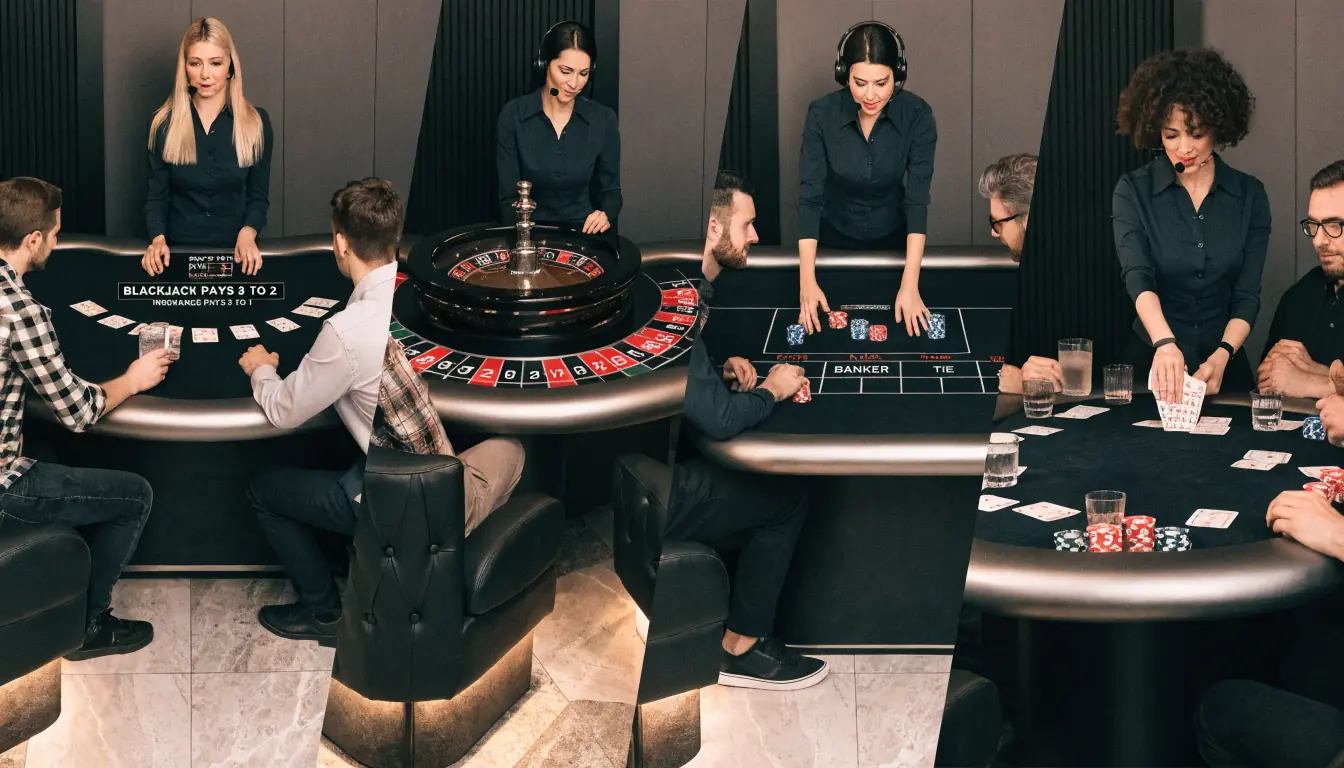
Common formats you’ll run into:
- Live blackjack — standard rules, dealt by a person, usually with side bets bolted on
- Live roulette — European or American wheels, spun for real, ball drop and all
- Live baccarat — popular with a certain type of player who takes it very seriously
- Live poker variants — Casino Hold’em and similar, dealer-run rather than software-run
Live dealer games are only available through offshore operators, as no Australian licence covers them.
I’ll get into which of these are actually easy to find on Australian-facing sites a bit later — that’s its own conversation. For now, the point is just: live dealer means a human running the show, streamed to you, in something close to real time.
Why This Distinction Actually Matters
You’d think "it’s all just gambling" and move on, but the mechanical difference changes the experience in ways that matter if you’re deciding where to spend your time and money.
Software-based games are fast. You can burn through fifty spins on a slot in the time it takes to order a coffee. Live dealer tables force a different rhythm — there’s a dealer talking, other players (real or represented by seat counts) placing bets, a natural pause between rounds. Some people find that tedious. I found it was the first time online gambling felt like it had any texture to it, rather than just tapping a screen and watching numbers change.
There’s also a trust element that’s hard to fake. With a random number generator, you’re taking the operator’s word — or a third-party auditor’s word — that the software isn’t rigged. With a live dealer, you’re watching the mechanism happen. A shuffled deck is a shuffled deck. A spinning wheel is a spinning wheel. It doesn’t make the games fair by default — the house edge is still built into the rules of blackjack or roulette regardless of who’s dealing — but it removes one specific layer of "just trust us" that software-only games ask you to accept.
None of this is a small niche anymore, either. The online gaming industry generally has grown into something worth billions of dollars, and it keeps expanding at a pace that outstrips a lot of other entertainment sectors — live dealer formats are a meaningful chunk of that growth, not a sideshow.
Where Australia Complicates the Picture
Here’s where I have to stop talking about the games themselves and start talking about the legal ground they sit on, because in Australia that ground is genuinely different from what players in the UK or parts of Europe are used to.
The Interactive Gambling Act makes it an offence for an operator to provide online casino games — live dealer tables included — to people residing in Australia. That’s not a vague guideline. It’s a specific offence, aimed squarely at the businesses running these platforms, not at the person sitting on their couch placing a bet. The penalties attached to it aren’t small either: up to AU$360,000 per day for an individual found in breach, and up to AU$1.8 million per day if it’s a corporation. Per day. Not a one-off fine.
Heavy Fines
Providing live dealer casino games to Australian residents can result in penalties of up to AU$1.8 million per day for corporations.
What that means in practice is that no operator can legally hold an Australian licence and offer you a live dealer blackjack table. The licensing structure for that kind of product simply doesn’t exist domestically. Every live dealer casino an Australian player ends up using is, by definition, operating from offshore — running under a licence issued somewhere else entirely, serving Australian traffic in a legal grey zone that the operator carries all the risk for.
And that last part is the piece people usually get wrong when they first hear about this law. The offence sits with the operator, not with the player. Australian residents who deposit money at offshore casinos face no criminal exposure for doing so. You’re not breaking the law by placing a bet on a live dealer table from your phone in Brisbane — the platform offering you that table is the one exposed to the AU$1.8 million-a-day penalty structure, assuming Australian regulators can even reach it, which is its own separate problem.
That’s an important distinction to sit with before going any further into this topic, because it shapes everything about how the market actually functions here. It’s why you won’t find local licensing bodies vouching for these platforms, why "recommended" lists tend to be built on reputation and track record rather than any government seal of approval, and why the whole live dealer scene available to Australians exists in a kind of parallel structure — real games, real dealers, real money, running on licences issued somewhere the Australian government has no jurisdiction over.
I’m not saying that to scare anyone off. I’ve played plenty of hands on these tables myself and never had a knock on the door for it. But understanding this one fact — operator liability versus player exposure — changes how you should read literally everything else in this space, from bonus terms to which sites are worth your time. It’s the piece of context that the rest of this guide is going to keep circling back to, so it’s worth having straight before we go any further into how the broader Australian casino landscape is actually put together.
Understanding Australian Casino Landscape
Before you can make sense of where live dealer platforms sit in Australia, you need to understand something most guides skip over: there’s no single body running the show. Australia doesn’t have one gambling regulator or one gambling law. It’s split between the states and the federal government, and each state has been left to write its own rulebook for gaming machines. That’s why what’s legal or standard in Queensland can look completely different in Victoria or Western Australia.
I found this out the hard way years ago, assuming a rule I’d read about in one state applied everywhere. It didn’t. Land-based gambling in Australia is a patchwork, not a system.
Land-Based Venues: Casinos, Pubs, and Clubs
Gaming machines here aren’t locked away in casino resorts the way they are in some countries. In several states, you’ll find them scattered through ordinary pubs and clubs, sitting next to the pool table and the bar. That’s a distinctly Australian setup, and it’s part of why land-based gambling feels so normalised here compared to other markets.
New South Wales is the heavyweight in this space. It was the first state to legalise poker machines, back in 1956, and it never really slowed down after that. Today NSW has 87,298 gaming machines spread across 2,195 venues. That’s not a typo you skim past — sit with the number for a second. It means the average venue holds around forty machines, and they’re not concentrated in a handful of mega-casinos. They’re everywhere, in suburbs, in country towns, in the local club you’d walk past without a second thought.
Gaming machines total 87,298 across 2,195 venues, averaging about 40 machines per venue.
All gaming machines are confined to the Crown Perth casino floor, reflecting a tighter regulatory approach.
Other states took different paths. Western Australia, for instance, confines its gaming machines to a single casino floor rather than letting them spread into pubs and clubs — a much tighter approach than what NSW settled on. I’ll get into the specific return rates and limits each state enforces later, but the point here isn’t the numbers themselves. It’s that "going to a casino" in Australia doesn’t mean the same thing depending on which state you’re standing in.
Why This Matters for Live Dealer Platforms
Here’s where it gets interesting for anyone trying to understand live dealer casinos specifically. All of that state-by-state regulation I just described applies to physical, land-based gaming machines. Live dealer casino sites operate in a completely different regulatory space — one shaped by federal law rather than state licensing boards. The rules that govern how many machines a pub can have, or what a venue’s payout rate needs to be, simply don’t touch online live dealer platforms at all.
That’s the disconnect a lot of Australian players never quite grasp. You might live in a state with thousands of regulated, licensed gaming machines down the road, and assume that same regulatory comfort extends to the live blackjack table you’re playing on your laptop at midnight. It doesn’t. The land-based system and the online system aren’t cousins — they’re barely acquainted.
This is exactly why I dedicate later sections of this guide to the federal law that actually governs online gambling in Australia, because it’s a different beast entirely from the state-run machine licensing described above. If you’ve ever wondered why a "casino" you found online doesn’t look or feel anything like the licensed venues you’d recognise from a night out, this split is the reason.
The Ecosystem, Mapped Out
Think of it in layers:
- State level — governs physical gaming machines in casinos, pubs, and clubs. NSW, as the pioneer since 1956, still runs the largest network by far.
- Venue level — the actual pubs, clubs, and casino floors where those machines physically sit, varying enormously by state in how open or restricted they are.
- Federal level — governs online interactive gambling, including where live dealer platforms fall, completely separate from the state machine rules above.
I lay it out this way because most players approach live dealer casinos with a mental model built from land-based experience — walking into a venue, seeing machines regulated by a state authority, assuming the online version works the same way with some digital paperwork attached. It doesn’t work that way. The two ecosystems run on parallel tracks that rarely intersect.
Once you get that distinction straight, the rest of this guide makes a lot more sense. The next sections deal with bonuses, crypto, and specific legal questions around live dealer play — all territory that belongs to the federal side of this split, not the state-based machine landscape covered here.
Bottom line: land-based Australia is diverse and heavily populated with machines, especially in NSW. Online live dealer Australia is a different animal, governed differently, and that gap is where most of the confusion — and most of the questions I get asked — actually comes from.
Are Live Dealer Bonuses Worth It? The Bitcoin Angle
I used to screenshot every "welcome bonus" banner I saw. Match this, get that, free spins on a table game that doesn’t even have spins. Then I actually tried to use one on a live blackjack table and realised half of them are written by someone who’s never sat at a live table in their life.
Here’s the thing nobody tells you upfront: online casino services, including anything you’d call a live dealer bonus, are prohibited in Australia under the Interactive Gambling Act 2001. Not “regulated.” Not “taxed differently.” Prohibited. So every glossy bonus page you land on, promising a stack of bonus funds for signing up to a live dealer table, is being served to you by an operator that has no legal standing to offer it to an Australian resident in the first place.
Bonus Illegal
Live dealer bonuses are prohibited under the Interactive Gambling Act, so any bonus offer to Australian players lacks legal standing.
That doesn’t make the bonus fake. It makes the whole arrangement sit in a grey zone where the operator is offshore, the promise is real enough on paper, and the protection you’d expect from a licensed market simply isn’t there.
Why the Bitcoin angle makes it messier
Bitcoin bonuses get pitched as the modern, borderless version of the same offer. Deposit in crypto, get a bonus, play live baccarat, cash out. Sounds clean. It isn’t, for one simple reason: these sites are the same prohibited services mentioned above, just with a different payment rail attached.
I’m not going to pretend I know every operator’s fine print — that’s not the point here. The point is that a bonus tied to a currency doesn’t change what kind of service is sitting underneath it. If the underlying live dealer casino offer is already outside what Australian law permits, wrapping it in Bitcoin doesn’t legitimise it. It just adds a layer of anonymity that makes it harder for anyone — you included — to know who you’re actually dealing with.
What actually happens to these sites
This isn’t theoretical. ACMA has blocked more than 1,564 illegal gambling sites since November 2019, using referrals under section 313 of the Telecommunications Act. That’s not a warning letter and a slap on the wrist — that’s the regulator asking internet providers to cut access.
So the bonus you signed up for last year might be sitting behind a domain that’s since been blocked. You wouldn’t necessarily know until you tried to log back in and got nothing.
My honest read on it
I don’t chase live dealer bonuses anymore, Bitcoin-flavoured or otherwise. Not because the offers are always worthless — some probably do pay out exactly as advertised — but because "worth it" assumes a baseline of recourse if something goes wrong. Wagering disputes, withdrawal delays, an account frozen for "verification." In a market where the service itself isn’t supposed to exist, there’s no one you can escalate to.
If a bonus looks generous enough to make you overlook that, it’s doing its job.
Bonuses aren’t the enemy here. The absence of a safety net is.
Live Dealer Roulette and the Crypto Question
Roulette with a real wheel and a real dealer is the game everyone asks me about first. Makes sense — it’s simple to watch, the table talk is half the fun, and you can actually see the ball drop instead of trusting an RNG animation. That’s the whole appeal of the live version: nothing to fake, nothing to wonder about.
Where it gets messy is the moment someone brings up betting with crypto on that same wheel.
I’ve had this conversation more times than I can count. Someone finds a forum post about a site letting Aussies spin roulette with Bitcoin stakes, gets excited, and asks me if it’s the smart way to play. Short answer: no.
Why the crypto angle doesn’t work here
It’s not about whether the roulette wheel itself is fair — plenty of live tables run straight, dealer and all. The problem sits one layer below the game, in how the site operates at all. A platform offering real-money roulette to someone in Australia, crypto or not, is already outside the rules. Adding a coin payment on top doesn’t fix that — it just adds a second problem stacked on the first.
Crypto Roulette Risks
The crypto wrapper does not fix the underlying illegality. Offshore sites offering Bitcoin roulette typically lack a verifiable address and provide support that disappears when issues arise.
And the sites pushing this hardest tend to be the same ones with no fixed address, no license anyone can check, and a "support team" that vanishes the moment you ask where your withdrawal went. I’ve seen the pattern enough times to stop being surprised by it.
Here’s the part people don’t expect: getting to that roulette table isn’t guaranteed to stay easy. The ACMA has the power to order internet providers to block gambling sites it considers illegal. I’ve had bookmarked casino URLs go dead overnight — no warning, no email, just a blocked page where the roulette lobby used to be. If the operator behind that crypto-roulette table gets flagged, the regulator can also pass on the names of its directors or principals to border protection agencies. That’s not a slap on the wrist aimed at players — it’s aimed at the people running the show, but it tells you how seriously this gets treated on the operator side.
None of that touches you directly as a punter placing bets. But it does mean the site you liked yesterday might not load tomorrow, your account history disappears with it, and any crypto sitting in that wallet is now sitting somewhere you can’t reach.
What I actually tell people
If you’re chasing live dealer roulette because you like the real-table feel, that’s a reasonable thing to want. If you’re chasing it because someone promised crypto bets make it faster or more private, slow down. The speed of the deposit has nothing to do with whether the table — or the whole site around it — is still standing next week.
Roulette hasn’t changed. The wheel does what it’s always done. It’s the crypto wrapper around it that turns a straightforward game into a much riskier bet than the one on the felt.
Live Dealer Game Selection: What You Can Play
Forget the crypto talk for a second. What actually matters when you sit down at a live table is simple: what’s on offer, and how it compares to the gaming machines you already know from the pub down the road.
Blackjack is everywhere. Every platform worth its salt runs multiple tables, sometimes with side bets bolted on, sometimes stripped back to basics. Roulette I’ve already covered — European wheels, mostly, with a dealer spinning instead of a random number generator doing it in silence.
Baccarat is the one Aussies underrate. It’s slower, less flashy, but it’s where I’ve actually seen the most consistent play from other punters at the table — people who know the game, not just clicking buttons.
Then there’s the game show hybrids — wheel-spin formats, dice games, that sort of thing. They’re dressed up with lights and hosts who talk to the camera like it’s a quiz night. Fun for twenty minutes. Not something I’d build a session around.
How it stacks up against what you know
Here’s the comparison that actually helped me understand the difference. In Queensland, gaming machines in pubs and clubs run a return rate of at least 85%, and casino floors bump that to 90%. Victoria sets its own floor at 85% for machines, with a $50 cap on note acceptors. Western Australia goes further and keeps all its electronic gaming machines confined to the Crown Perth casino, sitting at a 90% return rate.
Live dealer tables don’t work that way. There’s no "return rate" printed on a roulette wheel — the house edge comes from the rules of the game itself, not a chip inside a machine. Blackjack’s edge depends on the rule set at that specific table. Baccarat’s is fixed by the bet type. Roulette’s is fixed by whether it’s single or double zero. None of that is regulated the way machine percentages are in Queensland, Victoria or WA, because none of it happens on a gaming machine sitting in a pub.
That’s the real difference in "what you can play" versus what you’re used to. Machines have a mandated floor. Live tables have a mathematical one, baked into the rules, that nobody’s required to disclose the same way.
So when you’re picking a table, you’re not checking a return-rate sticker. You’re checking the rule variant — how many decks, whether the dealer stands or hits on certain totals, whether there’s a tie bet worth touching. Different homework, same instinct: know what you’re actually betting on before the cards move.
Can You Use Bitcoin at Australian Live Dealer Casinos?
Short answer: not legally, no matter what a site’s payment page tells you.
Bitcoin Not Allowed
Using Bitcoin to fund live dealer gambling is not a permitted payment method in Australia, regardless of the operator’s location.
I got asked this so many times by mates that I actually went looking for a straight answer, and the straight answer is that digital currencies can’t be used for gambling payments in Australia. Full stop. Doesn’t matter if it’s a live blackjack table, live roulette, or a pokies app — Bitcoin as a gambling payment method isn’t something you’re allowed to use here, and any platform telling you otherwise is skating around rules it shouldn’t be skating around.
Here’s the confusing part, and it’s the same confusion I ran into with the bonus stuff earlier: Australia doesn’t have one single gambling law that covers everything. Regulation gets split between state and territory bodies and federal legislation, which means there’s no one office you can ring to get a clean yes or no on crypto specifically. Each state handles its own gaming machine rules, its own venue licensing, its own caps — New South Wales, for instance, brought in a cash‑input limit of $500 on new gaming machines back on 1 July 2023, which tells you the direction regulators are heading: tighter cash controls, not looser ones, and definitely not an opening for unregulated digital payments.
That fragmented system is exactly why some offshore live dealer sites can advertise crypto acceptance without anyone stepping in immediately. They’re not operating under Australian oversight in the first place, so they’re not bound by the same payment restrictions a licensed local operator would be. Doesn’t make it legal for you to use. Just makes it harder to police in real time.
What this means if you’re at the table
If you’re sitting at a live dealer game and the cashier window shows a BTC deposit option, that’s a signal about who’s running the site — not a feature to get excited about. I’ve seen it presented as some kind of premium option, like it’s for players who know what they’re doing. It’s not that. It’s a payment rail sitting completely outside any framework designed to protect you if something goes wrong with your funds.
No regulator here. No dispute process built for it. No safety net.
Seeing a BTC deposit option signals the site is operating offshore and beyond Australian consumer protections.
So when people ask me whether they can fund a live dealer session with crypto, I don’t answer with "technically" or "kind of." I tell them the honest version: it’s not a permitted payment method for gambling in this country, and the absence of a single regulator doesn’t mean the absence of a rule — it just means enforcement looks different depending on where the operator sits.
Live Dealer Casino Providers: My Personal Reviews
Here’s where I stop talking regulations and just tell you what actually happened when I sat down at these tables.
Playtech rooms are the ones I keep coming back to. The stream quality holds up even on a mediocre connection, and the dealers move at a pace that doesn’t feel rushed or dead slow. I’ve had chat lag once or twice, nothing that ruined a session. If you want a "premium experience" — their words, not mine — this is the closest I’ve found to it actually feeling that way at the blackjack tables specifically.
NextGen shows up less often, usually bundled into a wider live casino lobby rather than standing on its own. When I did run into their tables, the interface felt a step behind Playtech’s — slower to load between rounds, fewer camera angles. Not bad, just not something I’d go looking for on purpose.
None of this is regulatory advice, by the way — that’s a different conversation entirely. This is just me telling you which providers made me want to stay logged in and which ones made me check my phone between hands.
A word on the sites hosting these providers: they’re offshore, and that matters more than most reviews admit. BetStop, the national self-exclusion register, had 49,382 registrations as of 30 September 2025 — a real number of people who wanted out. But BetStop only binds around 150 Australian-licensed wagering providers. The offshore casinos running these live tables sit completely outside that system. Self-exclude all you want through the official register; it does nothing to stop you logging into an offshore site the next day.
So my "review" isn’t just "does the roulette wheel spin nicely." It’s also "if you ever needed to walk away, would this platform even notice." Worth sitting with before you judge a provider purely on stream quality.
Top Live Dealer Casinos for Australian Players in 2026
Ranking anything as "top" for 2026 feels a bit dishonest without a caveat first: none of this is licensed onshore, so "top" here means better run, not legal. That distinction matters more than which studio the dealer works for.
I’m not rehashing the provider breakdowns from the last section. This is about where the overall package — deposits, game spread, how they treat you when something goes wrong — actually adds up to something worth your time and money.
What I weigh, in order:
- How they handle your money. Withdrawal friction is the tell. A site that stalls a payout after a win is telling you everything about how it’ll treat you long-term.
- Table variety that isn’t just blackjack with a paint job. If baccarat, roulette and blackjack all run through the same three studios, you’re not getting real choice, you’re getting the same product three times.
- Support that answers before you’ve given up. Sounds basic. Most fail it.
I’m not naming a definitive winner, because the landscape shifts fast and offshore operators come and go without warning — that’s the trade-off you accept the moment you sign up with anything outside Australian licensing.
Key Takeaways
- Live dealer casinos for Australians are offshore and operate outside local licensing.
- Bonuses and crypto payments are prohibited under the Interactive Gambling Act.
- Operator liability is heavy, but players face no criminal risk.
- Choose providers with reputable studios and be prepared for potential site blocks.
For scale, look at what’s happening onshore instead: the Northern Territory alone licenses roughly 40 online wagering brands pushing something like AU$50 billion through the system annually. That’s the size of the regulated market you’re stepping outside of when you pick an offshore live dealer site. It’s not a small decision dressed up as a casual one.
Victoria’s move to mandatory carded play for pokies from December 2025 is a land-based change, but it says something about direction — regulators are tightening identity checks everywhere, and offshore live dealer sites sit completely outside that trend. No card, no register, no oversight. That’s the appeal for some players and the exact reason others avoid it entirely.
Rank by that filter first. Everything else is preference.
Playing Live Dealer Games for Real Money: Legal Reality
Here’s the part nobody explains straight: putting real money on a live dealer table isn’t a grey area, it’s just plainly against the rules for anyone offering it to you from Australia. No overarching gambling statute exists that covers everything in one place, but the Interactive Gambling Act does the heavy lifting here, and it’s blunt about online casino games being off the table entirely.
People assume the racing exception applies to casino games too. It doesn’t. That exception is specifically about in-play betting on live sports events other than racing — a completely different problem, and one that has nothing to do with a live blackjack table or a roulette wheel streamed from a studio.
So where does that leave the actual gambling you can do legally, with a dealer, for cash? Basically nowhere online. The only real-money live-format gambling built into Australian law lives inside physical venues. Western Australia is the clearest example — gaming machines there are locked to the Crown Perth casino floor, nowhere else, no pubs, no clubs. That’s the kind of hard boundary state regulation draws: a specific venue, a specific machine count, no ambiguity.
Live dealer tables you find online don’t fit into that structure at all. They’re not licensed the way a Perth casino floor is licensed. That’s the legal reality, stripped of marketing language: real money at a live dealer table, played from home in Australia, sits outside the framework the law actually recognises.
I’m not telling you what to do with that. I’m telling you what the law says, which is more than most sites bother to.
Best Online Casinos with Live Dealers for Aussie Gamers
So what actually matters when you’re picking a casino with live dealer tables, beyond the tables themselves? Everything I’ve covered in this guide — the licensing gaps, the bonus fine print, the game variety — comes together here.
If you’re used to Victoria’s poker machine rules, where the default 24-hour loss limit sits at AU$50 and you can only load AU$100 per session, live dealer play online has none of that built in. No automatic cap stops you. That’s not a bonus feature, it’s a warning: you’re the only limit that exists.
One thing that actually works in your favour — any winnings you pull from a live dealer table aren’t assessable income if you’re not playing professionally. The tax office doesn’t want a cut. Small comfort, but real.
Pick a platform with a decent spread of tables, dealers who don’t feel like they’re phoning it in, and payout terms you can actually read without a law degree. That’s the whole checklist. Everything else is marketing.
Will I get in trouble for playing at an offshore casino?
No, you face no criminal exposure for depositing at an offshore casino. The Interactive Gambling Act targets the operator, not the player — the penalties of up to AU$360,000 per day for individuals and AU$1.8 million per day for corporations apply to the business offering the games, not to you placing a bet.
What are the main laws regulating online gambling in Australia?
Australia has no single overarching gambling statute; regulation is split between state/territory and federal levels. The federal Interactive Gambling Act 2001 prohibits operators from offering online casino games, slots and poker to Australian residents, and also bans in-play betting on live sports events other than racing.
What is ACMA and how does online gambling regulation work in Australia?
ACMA is the Australian Communications and Media Authority, which enforces the Interactive Gambling Act by ordering internet service providers to block illegal gambling websites and can notify border protection agencies about directors or principals of offshore operators. It has blocked more than 1,564 illegal gambling sites since November 2019.
What responsible gambling tools do Australian casinos offer?
Australia runs BetStop, a National Self-Exclusion Register operating nationwide since August 2023, which had 49,382 registrations as of 30 September 2025. However, it only binds around 150 Australian-licensed wagering providers, meaning offshore casinos sit outside its coverage.
What state has the strictest pokies laws?
Western Australia is the strictest, restricting electronic gaming machines entirely to the Crown Perth casino floor, with about 2,500 machines and a 90% minimum return rate — no pokies in pubs or clubs at all, unlike other states.
What does the IGA actually prohibit?
The Interactive Gambling Act 2001 prohibits operators from providing online casino games, slot machines and poker services to people in Australia, and it also bans in-play betting on live sporting events other than racing when offered online.
Prepared by the Outback Luck editorial staff.