
Australian Casino Rankings: A Practical Guide
 Available in US
Before you sign up anywhere, it helps to see how a shortlist of casino brands stacks up so you can narrow down where to spend your time and money.
Thor Casino is a name worth knowing if you’re exploring casino options, offering a straightforward gaming experience for those who want to get started quickly.
Betvictor is a well-established name in the betting and gaming space, known for catering to players looking for a broad entertainment offering.
Tabcorp carries a long-standing reputation in the wagering and gaming industry, making it a familiar choice for those who value an established brand.
Vegaz Casino stands out as an option for players seeking a casino-focused experience with a clear gaming theme.
Jeetcity Casino offers a casino experience aimed at players looking for a dedicated gaming platform.
JustCasino presents itself with a simple, no-frills approach for players who want a straightforward casino experience.
WinSpirit Casino is geared toward players looking for an accessible casino option with a clear gaming focus.
Betfair is a globally recognised name in betting and gaming, known for its long history in the wagering industry.
CasinoStars offers a dedicated casino experience for players seeking a gaming-focused platform.
Lucky Dreams is positioned as a casino option for players interested in a themed gaming experience.
Table of Contents
- Top Australian Casino Rankings and How to Choose a Guide
- Understanding Bonuses and Promotions Restrictions in Australia
- Payments and Withdrawals: What Australian Players Can Actually Use
- Game Offerings Available to Australian Gamblers
- Mobile Access and Physical Casino Locations Down Under
- Safety Measures and Licensing Landscape for Australian Casino Players
Top Australian Casino Rankings and How to Choose a Guide
I used to think ranking a casino was simple: biggest floor, most tables, loudest lights, done. Then I actually spent time asking pit staff how their venue got licensed, and realised most “rankings” you find online are just affiliate lists ordered by who pays the most commission. That’s not a ranking. That’s an ad with a scoreboard graphic.
Here’s the thing that changes how you should read any Australian casino guide: this country doesn’t have one gambling regulator you can point to and say “that’s the authority.” Regulation is split between the states, the territories, and the federal government, each running its own licensing regime for land-based venues. A casino ranking that treats Australia like a single market with one rulebook is already wrong before you get to the games list.
What a real ranking actually checks
When I sit down to compare Australian casinos now, I ignore the marketing copy first and look at four things:
- Who actually licenses the venue. Land-based casinos answer to their state or territory regulator, not a national body. A Sydney casino and a Perth casino aren’t playing under the same exact rulebook, even if the broad strokes look similar.
- Compliance history, not just the shiny lobby. A venue’s licence status tells you more than its restaurant reviews.
- Age verification at the door. Eighteen is the legal minimum to gamble anywhere in Australia, no exceptions, and any venue that’s loose about checking it should drop straight off your list.
- What happens when something goes wrong. How a casino’s regulator responds to a breach tells you more than any “5-star” badge on a comparison site.
That last point is why I stopped trusting glossy lists entirely. The Star Sydney is the clearest example I can point to: its casino licence was suspended in September 2024, and as of the most recent update it’s still suspended, expected to stay that way until at least 30 September 2025, on top of a $15 million fine. If a ranking published before that suspension still has the venue sitting at number one with no update, you’re looking at a stale page, not a guide.
Land-based versus what you’ll find online
This is where a lot of guides get sloppy, and it matters for how you use any ranking. Online casino games, slot machines and poker services are prohibited in Australia under the Interactive Gambling Act 2001. So when a site ranks “Australian casinos” and lists a bunch of offshore online platforms with polished graphics and welcome pages, it’s not ranking Australian casinos in the legal sense at all — it’s ranking foreign operators that Australians can technically reach but that hold no local licence.
There are no locally licensed online casinos in Australia. Full stop. Every online casino-style platform accessible to Australian players is operating from offshore. That doesn’t make using one a criminal act on your end — the Interactive Gambling Act targets the operators pushing these services into Australia, not the individual player who signs up. But it does mean any “top online casino Australia” list you read is really a list of offshore brands, and the ranking criteria should reflect that difference, not pretend these sites sit under the same oversight as a physical venue on Collins Street or George Street.
How I’d actually use a ranking
If you’re trying to pick where to spend a Saturday night at a physical venue, the ranking questions are straightforward: is the licence current, is there a recent enforcement action attached to the operator, and does the venue enforce age checks properly. You can usually find licence status through the relevant state regulator’s public register rather than taking a comparison site’s word for it.
If you’re looking at anything online, the question changes entirely. You’re not asking “which is the best licensed casino” because none of them are locally licensed. You’re asking which offshore platform has a track record that doesn’t involve disappearing with player funds — a much lower bar, and one that most flashy top-10 lists don’t even attempt to answer honestly.
I’ll be blunt about something I got wrong early on: I trusted a ranking that put a since-suspended venue near the top, because the list hadn’t been updated in months and I didn’t bother checking the regulator’s own notices. Cost me an evening and a fair bit of annoyance when I turned up and found half the floor closed pending review.
Lesson learned.
A ranking is only as good as the date it was last checked against the actual regulator, not the date it was last dressed up with new banner images. Treat every “best of” list as a starting point for your own five-minute check, not a final answer.
The bonus offers and payment methods these venues advertise are their own can of worms — and Australia’s rules there are stricter than most guides let on, which is exactly what we get into next.
Understanding Bonuses and Promotions Restrictions in Australia

The first time I saw a “match bonus” advertised on an offshore site, I did what everyone does: I skimmed the fine print, found nothing that scared me off, and signed up. What I didn’t check was whether that offer was even legal for someone sitting in Australia to claim. Turns out that’s the wrong question to start with. The right question is what the bonus is funded through, because that’s where the whole thing falls apart.
Here’s the part nobody explains upfront: most of the flashy welcome packages you see on international casino ads rely on credit-based deposits or crypto top-ups to trigger the offer. Both are off the table here. Credit cards have been banned for gambling deposits in Australia since June 2020, and that ban was reinforced on 11 June 2024 when the rule was extended specifically to online gambling deposits. Then the 2023 amendment to the Interactive Gambling Act went further, prohibiting not just credit cards but credit-related products and digital currency for online wagering altogether. So a bonus structured around “deposit with your card, get double” isn’t a grey area you can quietly use — it’s built on a payment method that’s already illegal for this purpose.
Why the bonus itself isn’t the problem — the funding is
People assume the restriction is about the promotion. It’s not, really. The restriction is about what you’re allowed to put money in with. A bonus tied to a deposit method that’s banned is automatically unavailable to you, no matter how it’s worded on the landing page. That’s why you’ll notice Australian-facing offers look different from what’s advertised on US or European versions of the same site — same brand, quieter promo page.
What that leaves on the table
Offshore platforms serving Australian players generally keep bonus structures that don’t depend on prohibited funding:
- Promotions tied to bank transfers or PayID deposits, since those aren’t affected by the credit or crypto restrictions.
- Loyalty-style rewards that accrue from regular play rather than a specific deposit trigger.
- Free spins or bonus credit offered as a standalone gift rather than matched against a card payment.
None of this means every offer you see is clean. It means the mechanism behind it needs to survive the same test: is money moving through a channel that’s actually legal here. If the answer’s no, the bonus doesn’t matter — you were never going to be able to fund it properly in the first place.
Age verification isn’t a formality
Every bonus page has a checkbox about being 18 or over, and it’s tempting to click past it like a cookie banner. Don’t. The minimum legal gambling age in Australia is 18 years, full stop, and it’s the one rule that has zero flexibility anywhere in this industry. Operators check it because they have to, not because they’re being polite. If you’re helping a younger sibling or friend “just look” at an account, you’re not doing them a favour — you’re setting up a problem that surfaces later when identity verification catches up with the account.
Why the “you won’t believe this offer” ads don’t apply to you
I used to get annoyed seeing ads for offers that looked incredible, only to find out later they were geo-targeted to other markets and never actually available to an Australian account. It’s not bait-and-switch in the shady sense — it’s regulation. A promotion that leans on credit lines, buy-now-pay-later-style credit products, or crypto deposits can’t legally be extended to players here, so even if the banner shows up in your feed, the backend blocks it at signup or at the deposit stage. Save yourself the irritation and don’t chase those specific structures. If a deal only works because you’re funding it with a credit product or digital currency, it was never going to work for you anyway.
A short gut-check before claiming anything
Before I claim a bonus now, I run through three quick questions:
- What deposit method actually triggers this offer?
- Is that method one that’s legal for online gambling in Australia?
- Does the site ask for proper age verification before letting me deposit at all?
If the answer to the second question is “credit card” or “crypto,” I close the tab. Not because the bonus itself is a scam — plenty aren’t — but because the funding path is a dead end here regardless of how good the number looks.
None of this is about missing out. It’s about recognising that the promotions built around banned payment rails were never actually on offer to you, no matter how the ad was worded. The ones that are left — funded properly, gated by real age checks — are the ones worth your five minutes of reading the terms.
Rubbish in, rubbish out. Check the funding first.
Payments and Withdrawals: What Australian Players Can Actually Use
I used to think a casino’s payment page was the boring part. Skip straight to the games, right? Wrong. The payment page is where you find out whether the site actually works for someone in Australia, or whether it’s just a copy-pasted template built for players in Europe or Canada. I learned that the hard way, sitting there with a card that kept getting declined and no idea why.
Here’s the thing: not everything you’ll see advertised is something you can use. Some of it is flat-out banned, and knowing which is which saves you a wasted half hour typing in numbers that will never go through.
PayID: the one that actually works fast
PayID is the payment method I trust most now. It’s built for instant bank transfers, and Australian online casinos support it because it maps to your existing bank account without needing a new card or wallet. You link an identifier — phone number, email, that sort of thing — and the transfer happens almost immediately. No waiting three business days wondering if the money vanished into some processing queue. If you’ve used PayID for anything else in Australia, splitting a bill, paying a tradesman, it’s the same system, just pointed at a casino cashier instead.
E-wallets: MiFinity and Jeton
Below PayID on my list, but still solid, are e-wallets like MiFinity and Jeton. Both are offered for deposits and withdrawals at Australian online casinos, which matters because a lot of payment options only work one way. You can put money in, but getting it back out means a different process entirely, or a support ticket, or a wait. MiFinity and Jeton don’t have that problem. You fund the wallet, deposit from it, and withdraw back to it when you cash out.
The appeal is a layer of separation. Your wallet talks to the casino; your bank account talks to your wallet. If that sounds like paranoia, fine, call it paranoia. I still do it.
Prepaid vouchers: Neosurf and CashtoCode
Then there’s the deposit-only crowd: Neosurf and CashtoCode. These are prepaid vouchers, and I mean that literally — you buy a voucher with a code on it, punch the code into the casino, and the balance loads. Straightforward for putting money in.
What they won’t do is bring money out. These are deposit-only. If you win, you’re not getting a Neosurf voucher mailed back to you. You’ll need PayID or an e-wallet for the withdrawal side, so if you’re planning to use a prepaid voucher, set up a proper withdrawal method before you need one. Learned that lesson after a decent win with nowhere obvious to send it.
What you can’t use, and why
Two things get asked about constantly, so let’s deal with them directly.
Credit cards are prohibited for gambling deposits in Australia. Doesn’t matter which casino, doesn’t matter how legitimate it looks. If a site is letting you punch in a credit card number for a deposit, that’s a red flag about the site, not a workaround for you.
Cryptocurrency is also off the table as a payment method for gambling in Australia. You’ll see it mentioned on plenty of offshore sites because they’re built for a global audience where crypto is common. For Australian players, it’s not part of the legal picture, full stop. Interesting footnote though: where cryptocurrency withdrawals do get processed at some offshore operators, they can clear within minutes — faster than a lot of traditional banking rails. That speed is exactly why it’s tempting, and exactly why it’s worth staying away from given the legal restrictions here.
A quick comparison
| Method | Deposits | Withdrawals | Speed |
|---|---|---|---|
| PayID | Yes | Yes | Near-instant |
| MiFinity / Jeton (e-wallets) | Yes | Yes | Fast |
| Neosurf / CashtoCode (vouchers) | Yes | No | Instant deposit only |
| Credit cards | Prohibited | Prohibited | — |
| Cryptocurrency | Prohibited | Prohibited | — |
What happens to your winnings
One thing that surprises a lot of people: gambling winnings are generally not taxable in Australia, unless you’re running gambling as an actual business, which for the overwhelming majority of players simply isn’t the case. You don’t need to set aside a chunk for the tax office after a win. That’s genuinely one of the few parts of this whole system that works in the player’s favour without any asterisk attached.
Age checks come before any of this
Before any deposit method even becomes relevant, there’s a gate you have to pass through: the minimum legal gambling age in Australia is 18. Every legitimate payment provider ties into identity verification at some point, which means your name, your date of birth, and your payment method all need to line up. If you’re under 18, none of the methods above are available to you, and no voucher code or e-wallet trick changes that.
So that’s the real map: PayID for speed, e-wallets for flexibility on both ends, vouchers if you only need to get money in, and a hard no on credit cards and crypto no matter how convenient they look elsewhere. Set up your withdrawal method before you need it. Sounds obvious. Wasn’t obvious to me the first time.
Game Offerings Available to Australian Gamblers
Here’s where a lot of people trip up, and I did too, early on. You’d think “games” means whatever’s on the site in front of you. It doesn’t. What you’re legally allowed to play, and what an offshore platform will happily let you click into, are two different lists — and only one of them is clean.
The short version: pre-event sports betting, online lotteries, and some forms of bingo and keno are the permitted lane. That’s it. Everything that looks like a casino floor moved onto a screen — pokies, blackjack, roulette, online poker — sits outside that lane entirely, and no amount of slick design on the landing page changes that.
What’s actually allowed
Pre-event sports betting. You can place a bet on a match, race or event before it starts. That’s fine. What you can’t do is bet on it once it’s live and running online — the Interactive Gambling Act specifically bans in-play betting on live sports (racing is the exception, which is why you’ll still see people glued to their phones at the track). I learned this the annoying way, trying to back a comeback mid-match on an app that clearly wasn’t paying attention to its own rules. Bet got knocked back. Turns out that wasn’t the app being fussy — it was the law.
Online lotteries. Straightforward, and one of the least controversial parts of this whole space. Buying a ticket online for a lottery draw is permitted, no grey area here.
Bingo and keno — some of it. Not a blanket yes. Some bingo and keno offerings fall inside the permitted zone, others don’t, depending on how they’re structured and delivered. If a platform is vague about which category its keno game actually sits in, that vagueness is doing work — it’s hiding the answer, not simplifying it for you.
What’s off the table, full stop
Online casino-style games are banned outright for Australian residents. That covers the categories people usually associate with the word “casino” when they hear it — table games, electronic pokies, online poker rooms, blackjack, anything running on a random number generator dressed up as a slot reel. It doesn’t matter how the site brands itself or where it’s licensed offshore. If it’s serving casino-style games to someone in Australia, it’s operating outside what’s permitted here.
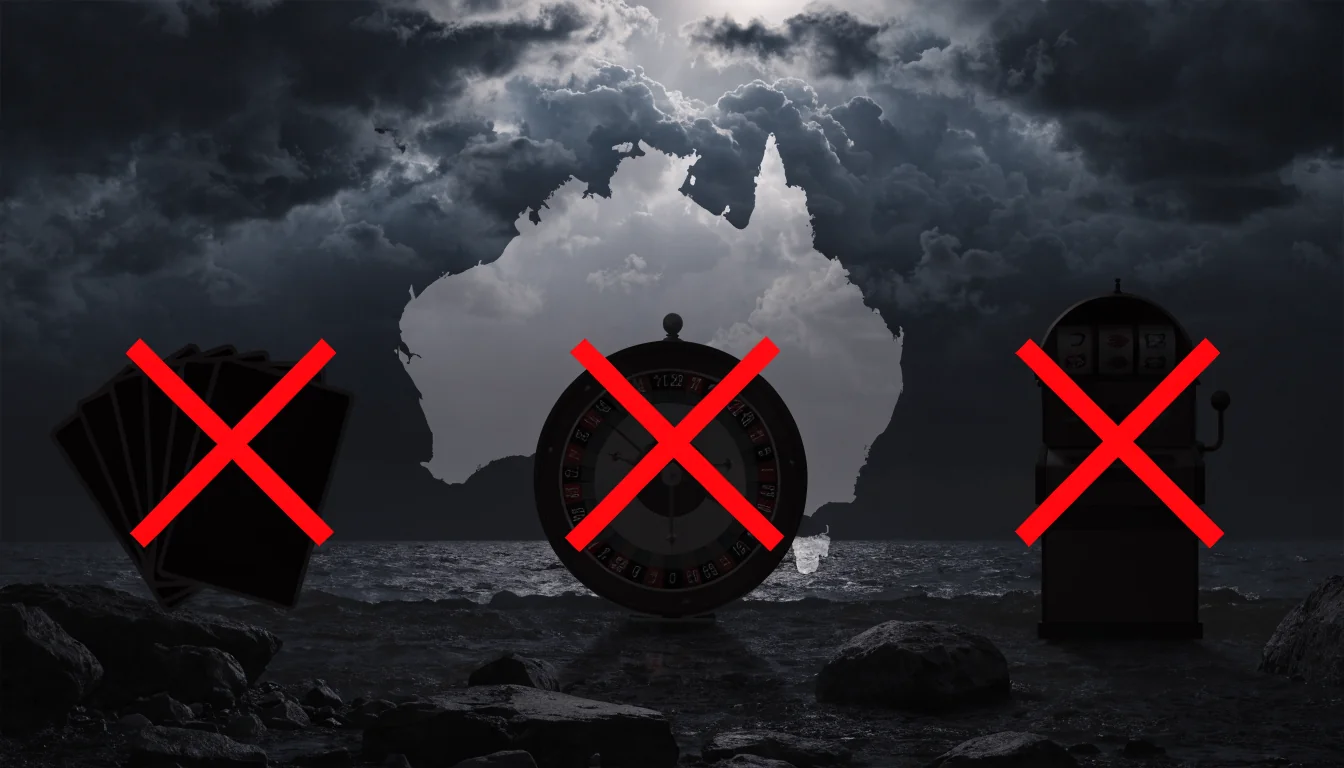
This is also where the marketing gets slippery. A site might list “keno” and “bingo” prominently on its homepage — genuinely permitted categories — and then quietly slot in a full suite of pokies and table games under a different tab. The permitted games aren’t a shield for the rest of the catalogue. Each game type stands or falls on its own.
Age comes first, before any of this matters
None of the above applies if you’re under 18. That’s the baseline for every single category listed here — lotteries, keno, sports betting, all of it. It’s not a detail buried in terms and conditions; it’s the first gate, and platforms that don’t check for it properly aren’t ones you want anywhere near your details anyway.
Advertising has tightened, and it shows
If you’ve noticed gambling ads feeling a bit more restrained lately in certain states, that’s not your imagination. Queensland, South Australia and Tasmania have brought in stronger advertising restrictions specifically targeting gambling games. It’s part of a broader shift, and it’s worth knowing about because it changes what you’ll actually see promoted to you depending on where you live — the ad you get served in one state might not be the ad someone in another state sees for the exact same game category.
Why the categories matter more than the branding
I used to skim past this kind of detail, figuring “games” was games and the fine print didn’t change much. It changes everything. A platform advertising itself around bingo and keno is operating in permitted territory. A platform pushing pokies or online blackjack to Australian players is not, regardless of how it’s dressed up or what jurisdiction issued its licence.
So when you’re looking at what a site actually offers, the categories are the thing to check first — before bonuses, before design, before anything else. Ask what game type you’re actually being offered, not what the homepage banner calls it.
Quick reference — permitted vs. not:
| Category | Status |
|---|---|
| Pre-event sports betting | Permitted |
| In-play sports betting online (non-racing) | Banned |
| Online lotteries | Permitted |
| Bingo / Keno | Permitted in some forms |
| Online casino-style games (pokies, blackjack, poker, roulette) | Banned |
Keep that table in your head next time a site’s front page is all flashing reels and “play now” buttons. The categories that are actually fine for you don’t usually need the flashing.
Mobile Access and Physical Casino Locations Down Under
I used to think “mobile access” meant an app I could download from an Australian store, tap, and play. That’s not how it works here, and finding that out cost me a couple of hours I didn’t need to lose. There’s no local app. What you get instead is a mobile browser site, usually run from an offshore licence, optimised for a phone screen. You log in through Chrome or Safari, not through anything sitting on your home screen with an icon. Some sites let you save a shortcut that looks like an app. It isn’t one.
The games that load on that mobile browser are the same restricted list covered elsewhere — pre-event sports betting, lotteries, some bingo and keno. No pokies, no online blackjack, no in-play wagering on your phone, no matter how good the site looks on a 6-inch screen. If a mobile site is showing you a spinning reel or a live dealer table, you’re on something operating outside the rules, and that’s worth remembering before you type in a card number.
Where the real casinos actually are
The physical side is a different story entirely, and it’s the part people forget when they’re searching for somewhere to gamble in Australia. Land-based casinos are real, licensed, and open — Crown Perth being one of the names you’ll recognise, alongside venues run under Crown Resorts Limited more broadly. These aren’t grey-market operations. They’re taxed, audited, and regulated at the state level, which is a genuinely different regulatory universe from anything you’d find online.
Victoria is a useful example of just how tightly wound that state-level regulation is. Table games there get hit with a 21.25% tax on gross gaming revenue, gaming machines get 31.57%, and on top of both there’s a 1% community benefit levy stacked on. Retail wagering operators in the same state also pay a 15% point-of-consumption tax, though only on net wagering revenue above AU$1 million — so it’s not hitting every small operator the same way. None of that tax structure applies to the offshore sites you’d be using on your phone. It’s one of the clearest lines between the two worlds: the venue down the road answers to a state tax office, the site on your phone answers to nobody in Australia.
Location-specific restrictions are getting stricter, not looser
If you assumed the physical side was static — same casinos, same rules, forever — that’s not the trend. Regulators have been tightening things at the venue level in ways that don’t get much attention outside the state they happen in. Advertising near and around gambling venues has come under more scrutiny too, part of a broader pattern of states clamping down on how gambling gets promoted in public.
Meanwhile the online side, which technically has no “location” at all, is being fenced off in a very literal way. Since 2019, the Australian Communications and Media Authority has blocked over 1,200 illegal gambling and affiliate websites, and as of May 2026 that number sits above 1,050 sites blocked by ISPs specifically. Try loading one of these on your phone while connected to an Australian carrier and there’s a real chance it just won’t resolve. I’ve had it happen mid-session — site loads fine on a VPN, dead the moment I switch it off. That’s not a bug. That’s the block working as intended.
Self-exclusion doesn’t stop at the front door
One thing that surprised me is how self-exclusion has followed players from physical venues onto phones. BetStop, the national register, isn’t just a form you fill out at a casino cashier — it covers interactive services too, which is exactly the point given how much play now happens on a device rather than a casino floor. By the first quarter of 2026, more than 50,000 Australians had registered with BetStop. That’s a lot of people who decided the mobile convenience wasn’t worth what it was costing them.
What this actually means if you’re deciding where to play
- A physical casino visit puts you under state licensing, state tax rules, and on-site responsible gambling measures you can walk up and ask about.
- A mobile session puts you on an offshore platform, subject to the same game restrictions as everywhere else online, with no local licence backing it.
- ISP blocking means a site that worked last month might not load this month — that’s the regulator, not your connection.
- BetStop applies across both worlds, so registering isn’t a half-measure tied to one casino floor.
None of this is really about which is more “convenient.” Convenient was never the problem. It’s about knowing which set of rules — and which tax office, which regulator, which blocklist — actually applies to the screen in front of you.
Safety Measures and Licensing Landscape for Australian Casino Players
I used to think “licensed” meant one body somewhere had stamped a piece of paper and that was that. Took me a while to work out that Australia doesn’t run gambling that way at all. There’s no single regulator, no one law you can point to and say “that’s the rulebook.” It’s split across states and territories, with federal oversight layered on top for anything online. So when someone tells you a site is “licensed in Australia,” ask licensed by whom, for what, doing what exactly. Half the time the answer doesn’t exist, because the local regulators mostly deal with land-based venues and wagering, not offshore interactive casino platforms.
That messiness is actually the first thing worth understanding about safety here. It’s not one gate you walk through. It’s several different agencies, each watching a different slice of the picture.
Who’s actually watching

The Australian Communications and Media Authority — ACMA — is the one with real teeth online. It can’t shut down a foreign casino site directly, but it can order Australian internet service providers to block it. That’s the mechanism: not “banning” a site in some abstract legal sense, but making it unreachable from an Australian connection. ACMA can also pass on the names of directors or principals behind illegal offshore operators to border protection agencies, which is a slower burn but not nothing if you’re the person running one of these outfits and you ever plan to fly through Sydney.

On top of that, ACMA can issue infringement notices for ongoing breaches — as of 2026 these can run up to $234,750 per day for operators who keep contravening the rules. That’s not a fine you shrug off. It’s designed to make ignoring the law more expensive than complying with it, at least for anyone with assets reachable by Australian authorities.
None of this touches you as a player, though. That’s worth saying plainly: the Interactive Gambling Act targets operators, not the people using their sites. You’re not committing an offence by placing a bet online. The risk sits entirely on the platform’s side — which is exactly why so many offshore sites keep operating despite the blocks. They’re gambling with corporate exposure, not yours.
State by state, patchwork by design
Because there’s no single authority, enforcement looks different depending on where you are. Queensland, South Australia and Tasmania have all tightened advertising restrictions on gambling in recent years — fewer inducements, tighter controls on how these games get promoted to the public. Other states move at their own pace. If you’re used to a country with one gambling commission and one set of rules, this takes some getting used to. Australia’s approach is federal blocking plus state-level advertising and licensing rules, stitched together rather than unified.
I won’t pretend this is elegant. It isn’t. But it does mean there are multiple points where bad actors can get caught, even if no single body has the full picture.
BetStop and stepping away
If you’ve ever wanted out — properly out, not just “I’ll try to stop” — BetStop is the tool that actually works nationwide. It’s the National Self-Exclusion Register, running across the whole country since August 2023. One registration blocks you from licensed wagering services across Australia, not just one operator. That’s the point of it being national rather than site-by-site: you don’t have to remember every place you’ve ever signed up and email each one separately.
It won’t touch offshore interactive casino sites, because those sit outside Australian licensing entirely. But for the legal, licensed wagering and lottery services operating here, BetStop is a real off switch, not a suggestion.
Age checks and why they matter more than they look
The minimum legal gambling age across Australia is 18. Every legitimate operator has to verify this before you can open an account — not glance at a checkbox, actually verify it. If a site lets you through without asking, that’s not a shortcut in your favour. It’s a sign the operator isn’t following the basic rules everyone else has to follow, and that tells you something about what else they’re skipping.
What “safe” actually means here
Put plainly: there’s no such thing as a locally licensed online casino in Australia, so “safety” in this market isn’t about finding the one with the shiniest badge. It’s about understanding which parts of the system exist to protect you — age verification, self-exclusion, the ability to walk away without being treated like a criminal for having gambled online — and which parts exist purely to squeeze operators who break the rules.
If you’re struggling or just want to check where you stand, Gambling Help Online and GambleAware are real services, not marketing dressed up as concern. Worth knowing they’re there before you need them, not after.
That’s the landscape as it stands. Patchy, split across agencies, occasionally slow — but with real consequences attached for operators who cross the line, and real protections for you if you know where to look.
Created by the ”Outback Luck” editorial team.